As an endodontist, I am frequently asked the same apprehensive question: “Doctor, do I really have to pull my wisdom tooth? It doesn’t even hurt—can’t I just leave it?”
The short answer is: While a wisdom tooth can be a “blessing” for the lucky 1% who can manage it, for the other 99%, it is a ticking time bomb that threatens the health of your entire mouth. Today, I will break down the clinical criteria I use to decide between extraction and retention.
1. The “99% Rule”: Why Maintenance is Nearly Impossible
Theoretically, if a wisdom tooth is perfectly aligned and you have flawless oral hygiene, there is no reason to extract it. However, in clinical reality, I see only 1 or 2 out of 100 patients who can actually keep this area clean.
Because wisdom teeth are located at the very back of the oral cavity, they are physically difficult to reach with a toothbrush. Even if you think you’re brushing well, food debris and bacteria inevitably accumulate between the wisdom tooth and the second molar. My advice to patients is always: “Don’t lose a lifelong functional molar trying to save a useless wisdom tooth.”
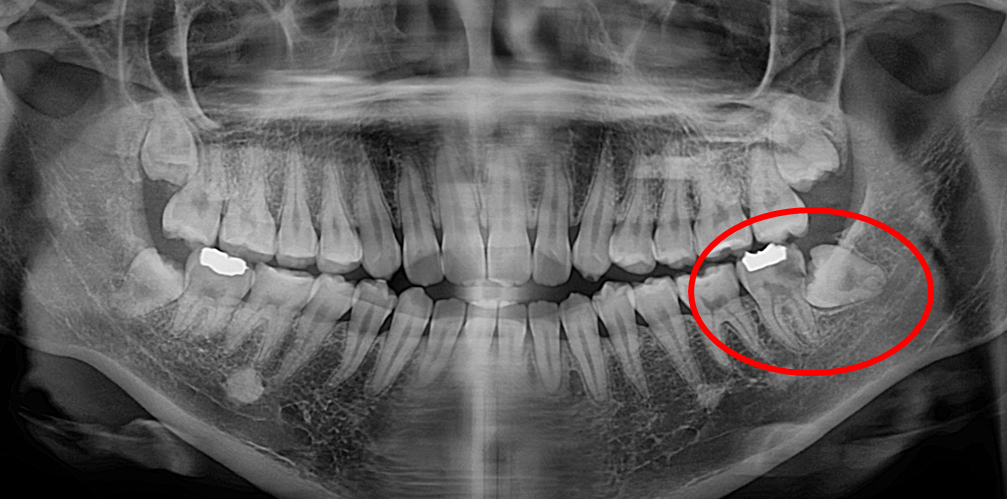
[Fig 1. Typical case of distal decay on the second molar caused by an impacted wisdom tooth] When extraction is delayed, the adjacent tooth often develops deep cavities. These are notoriously difficult to treat due to poor access, often requiring complex root canals or even resulting in the loss of both teeth.
2. High-Risk Scenarios: When Extraction is Non-Negotiable
① The “Tooth Crusher”: Mesially Impacted Teeth
A wisdom tooth that grows at an angle (mesial impaction) puts constant pressure on the second molar. This creates a “food trap” that leads to irreversible decay on the back of your healthy molar. This is the most common reason for emergency dental work in this area.
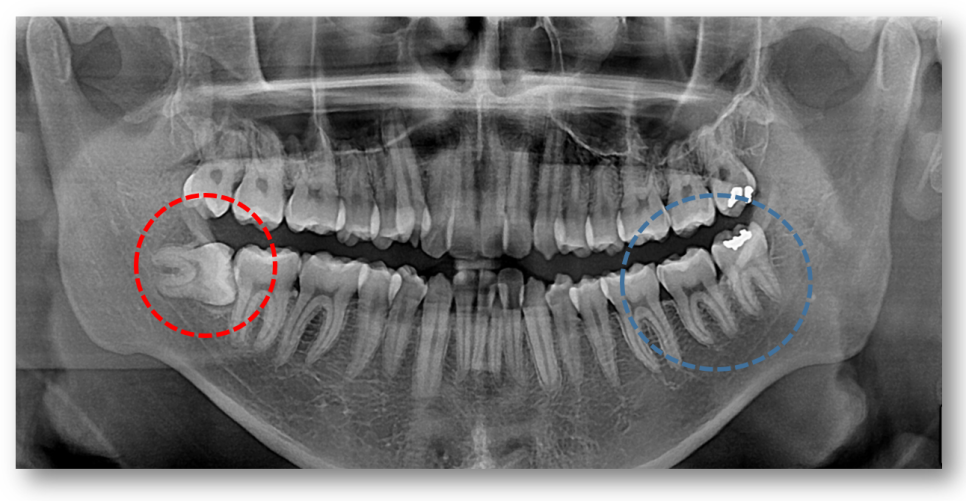
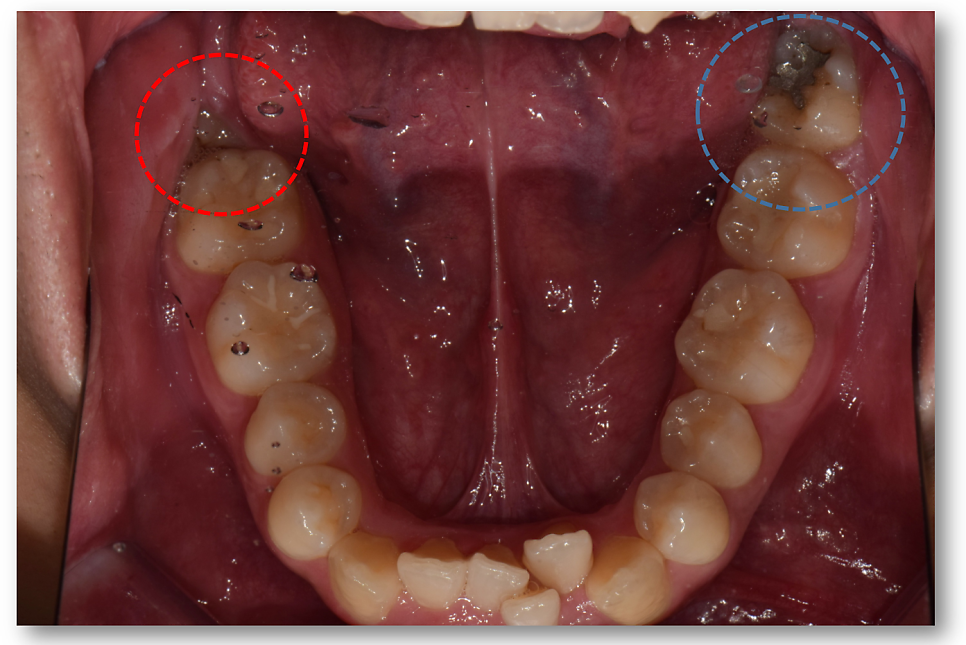
[Fig 2 & 3. Clinical and Radiographic comparison of “Safe” vs “Dangerous” wisdom teeth]
② Partial Eruption: The Gateway for Infection
A tooth that is only halfway out (partially erupted) acts as a pocket for bacteria. This leads to Pericoronitis—an inflammation of the gum tissue that causes swelling, pus, and severe halitosis (bad breath).
③ The Silent Threat: Dentigerous Cysts
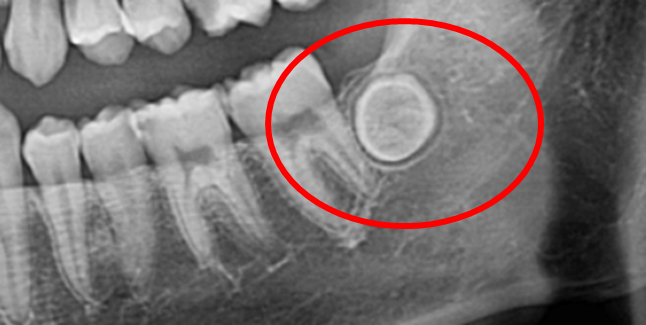
In rare cases, a fluid-filled sac (cyst) can form around an unerupted wisdom tooth. These are often painless but can progressively hollow out the jawbone, leading to fractures if left untreated.
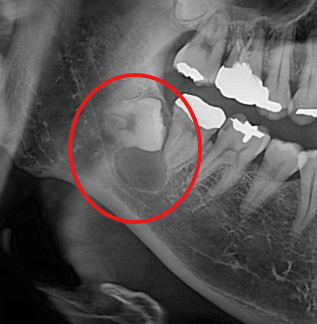
Figure 4. X-ray of a dentigerous cyst on an impacted wisdom tooth
3. The “Leave It Alone” Exceptions: When We Say No to Surgery
Not every wisdom tooth requires a trip to the oral surgeon. In certain cases, the risks of surgery outweigh the benefits:
Full Bony Impaction (Asymptomatic): If the tooth is completely buried in bone with no signs of infection or cysts, we often recommend “watchful waiting” through annual X-rays.
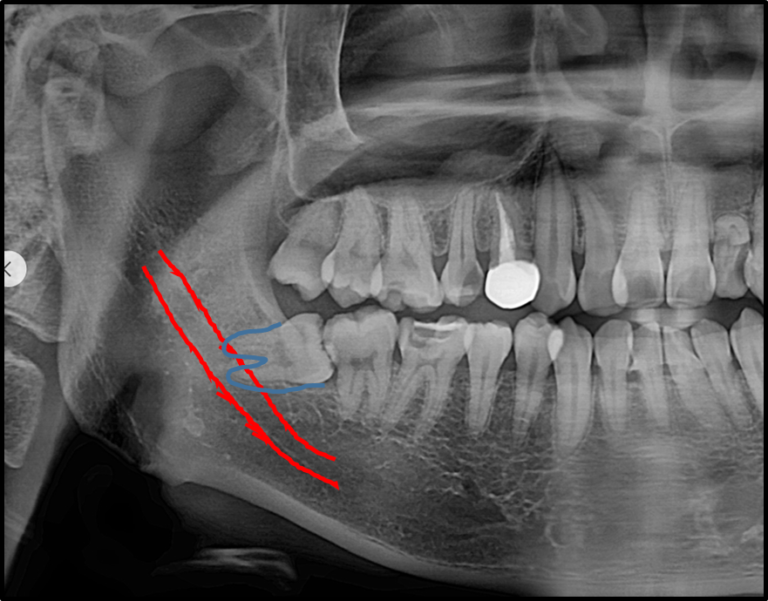
High Nerve Risk (Lower Jaw): When roots are entangled with the Inferior Alveolar Nerve, extraction poses a risk of permanent numbness. In such cases, we may choose to monitor the tooth or perform a Coronectomy (removing only the crown while leaving the roots).
Maxillary Sinus Proximity (Upper Jaw): If an upper wisdom tooth is deeply embedded near the sinus floor, extraction could cause a sinus perforation. If the tooth isn’t causing trouble, we leave it be.
The “Tooth Germ” Stage: We generally don’t intervene with developing “buds” in children unless they interfere with orthodontic progress.
4. Orthodontic Strategy: Clearing the Path
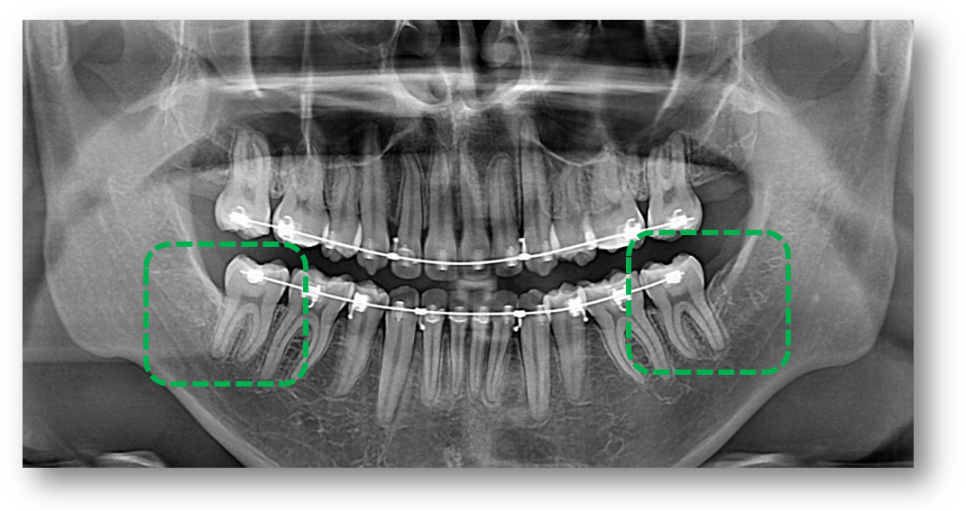
If you are planning braces or clear aligners, wisdom teeth are often “space invaders.” To move your other teeth back effectively and ensure long-term stability, preemptive extraction is usually the most efficient route to a perfect smile.
5. Final Thoughts: Don’t Wait for the Pain
Wisdom tooth pain is deceptive—it flares up when your immune system is down and then disappears. Many patients miss the “Golden Time” for extraction because they wait for it to hurt.
By the time you feel pain, the surrounding bone may already be damaged, or the adjacent molar may have a deep cavity. Saving your healthy teeth for a lifetime (into your 80s and 90s) is a far smarter investment than clinging to a problematic third molar.
“If you’re experiencing general tooth sensitivity rather than localized wisdom tooth pain, check out my guide: [Stop the Zap: An Endodontist’s Guide to Tooth Sensitivity]
📌 Checklist Before Your Extraction
- Panoramic & CT Scan: Essential for mapping nerve proximity.
- Specialist Consultation: For complex impactions, see an oral surgeon or a specialist who understands the 3D anatomy.
- Aftercare: Strictly follow post-op instructions to avoid the dreaded ‘Dry Socket.’
If you feel a “zing” or a dull ache in the back of your jaw, don’t wait. Your functional molars are far more valuable than your wisdom teeth.